
Why Your Glutes Just Don’t Feel Strong Anymore During Perimenopause
One thing that often surprises people is that gluteal tendinopathy isn’t simply a “weak glute” problem. During perimenopause the picture becomes even more interesting, because your tendons and muscles may not respond to exercise in quite the same way they did ten years ago.
“I’ve been doing all my exercises… so why does my hip still hurt?”
This is one of the most common questions I hear from women in their 40s and 50s.
Many have been stretching, walking and faithfully doing their home exercises. Some have even been completing clamshells every day because they’ve been told they need to “switch their glutes on”. Yet every time they lie on their side in bed, climb a hill or head out for a run, the outside of their hip reminds them it’s still there.
If this sounds familiar, you’re definitely not alone.
One thing that often surprises people is that gluteal tendinopathy isn’t simply a “weak glute” problem. During perimenopause the picture becomes even more interesting, because your tendons and muscles may not respond to exercise in quite the same way they did ten years ago.
The good news? That doesn’t mean you’re destined to have sore hips forever. It usually means your rehabilitation needs to become a little more specific.
What actually is gluteal tendinopathy?
Gluteal tendinopathy is irritation of the tendons that attach two important muscles, the gluteus medius and gluteus minimus, onto the outside of your hip. These muscles help keep your pelvis level every time you’re standing on one leg, climbing stairs, walking, running or simply balancing while putting your pants on.
When the tendon is exposed to more load than it can comfortably tolerate over a period of time, it becomes irritated. Many people first notice tenderness over the outside of the hip, discomfort when lying on that side in bed or pain after longer walks. Runners often tell me hills suddenly become much harder, while others notice standing on one leg to get dressed becomes surprisingly uncomfortable.
Why does it seem to happen around menopause?
This is where things become really interesting.
During perimenopause, oestrogen levels begin to fluctuate. Most people know oestrogen is important for reproductive health, but it also plays a role in maintaining muscles, bones and tendons. As hormone levels change, tendons may take longer to recover from loading and muscles often don’t respond to training quite as easily as they once did.
Many women tell me they don’t bounce back from exercise the way they used to. They feel like they’re still doing all the right things, yet they’re not getting the same strength gains or recovery. That can be frustrating, but it’s also very common.
This doesn’t mean exercise stops working. Quite the opposite. It simply means your body often benefits from a more progressive strengthening programme that gives the tendon enough challenge to adapt, while allowing enough recovery between sessions.
The biggest mistake I see
The biggest mistake I see is assuming the answer is more stretching or more activation exercises.
Clamshells, side leg raises and mini-band exercises all have a place, particularly early in rehabilitation when we’re trying to settle symptoms and improve muscle control. But your glute muscles are some of the strongest muscles in your body. Eventually they need to be challenged like strong muscles.
Imagine trying to prepare for a long hike by lifting a coffee cup every day. That’s often the equivalent of what we’re asking our glutes to do.
The goal isn’t simply to “activate” the muscles. The goal is to progressively build the strength and capacity of both the muscles and, more importantly, the tendon that has become sore.
So how do you strengthen your glutes?
There isn’t one perfect exercise.
The best programme depends on how irritable your tendon is, your current strength, your goals and what you’re hoping to get back to. Someone training for a half marathon needs a very different programme from someone who simply wants to walk the dog comfortably.
That said, I generally like to progress rehabilitation through several stages.
Stage 1: Calm the tendon
If everyday activities are painful, our first goal is to settle the tendon while maintaining strength.
This often includes isometric exercises. These are sustained muscle contractions where the muscle works without much movement through the joint.
Some examples include:
- Single leg wall pushes
- Supported bridge holds
- Standing hip abduction holds against a wall
- Isometric hip hikes
These exercises often provide short-term pain relief while introducing gentle loading to the tendon.
Stage 2: Build strength
Once pain has settled, it’s time to progressively challenge the glutes.
This is where I often see people staying too light for too long. The glutes are designed to be powerful muscles and eventually they need meaningful resistance.
Some of my favourite strengthening exercises include:
- Heavy hip thrusts
- Bulgarian split squats
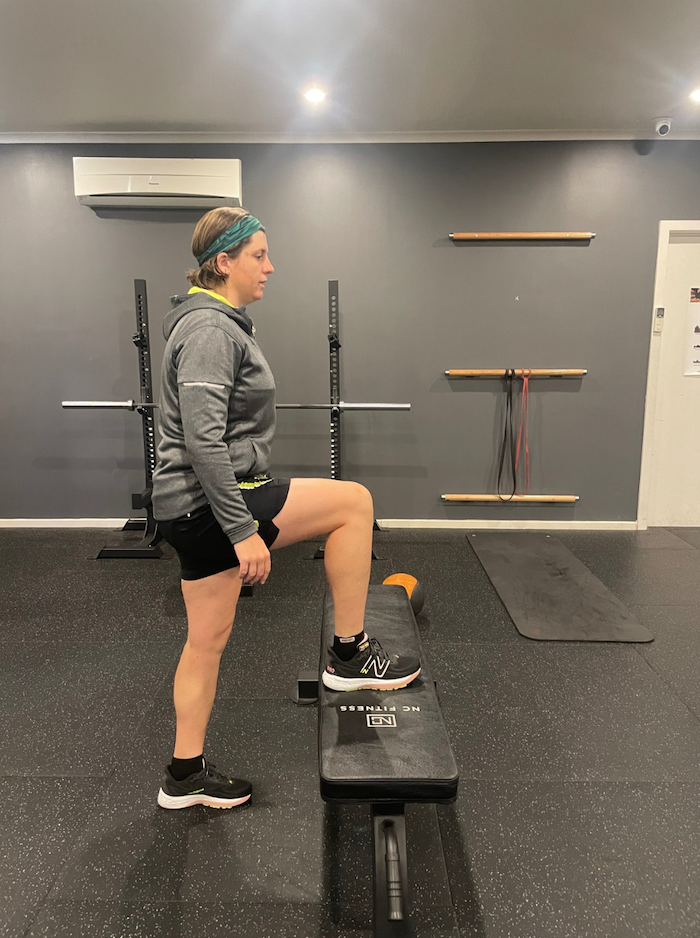
- Step ups
- Single leg Romanian deadlifts
- Cable hip abduction
- Single leg leg press
- Lateral step downs
- Single Leg Hip Hinge with Adductor Activation
The goal isn’t simply to complete lots of repetitions.
The goal is progressive overload. Gradually increasing resistance over time allows both the muscles and tendon to adapt.
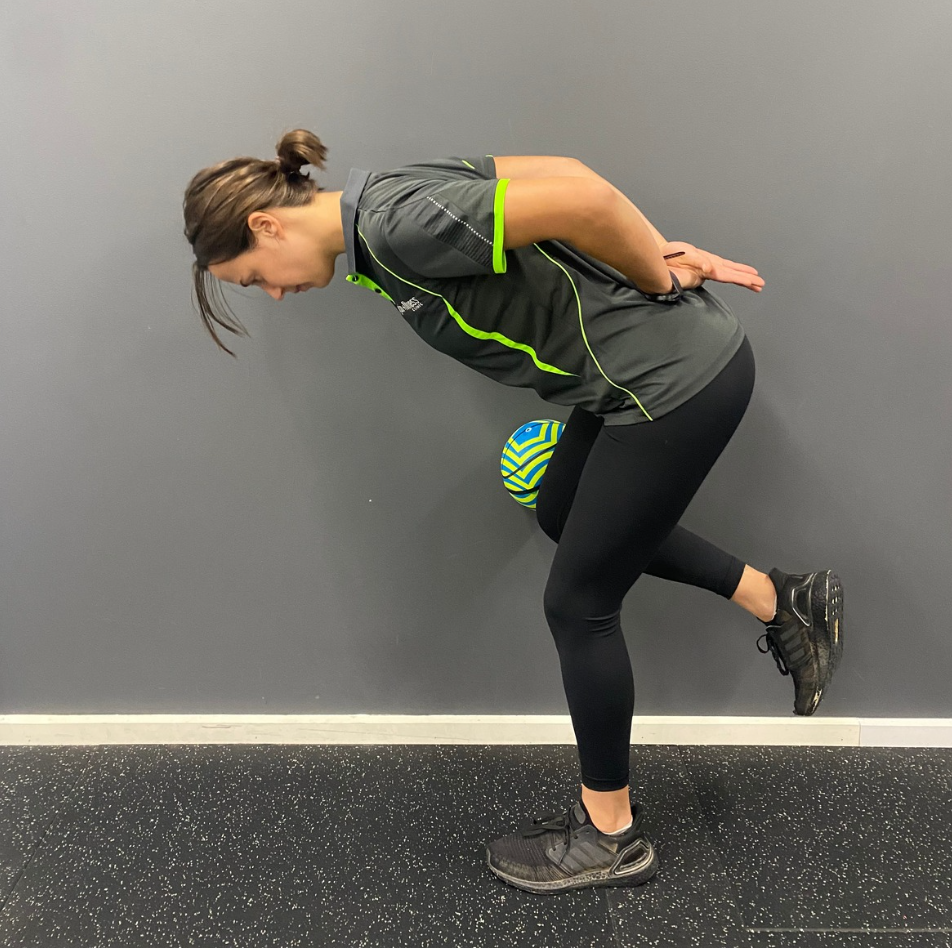
Single Leg Hip Hinge with Adductor Activation
Stage 3: Build tendon capacity
As strength improves, we then need to prepare the tendon for the loads it experiences in everyday life.
This might include:
- Walking longer distances
- Climbing hills
- Single leg balance challenges
- Farmer’s carries
- Lateral movements
- Controlled step-down exercises
These bridge the gap between gym strength and real-world movement.
Controlled step-down exercise
Balance & Core Work
Balance naturally declines with age; improving it helps prevent falls.
Single Leg Sit to Stands strengthens legs and improves balance when moving
Single Leg Squats enhances lower-body stability and strengthens hips, knees, and ankles
Stage 4: Return to running and higher level activity
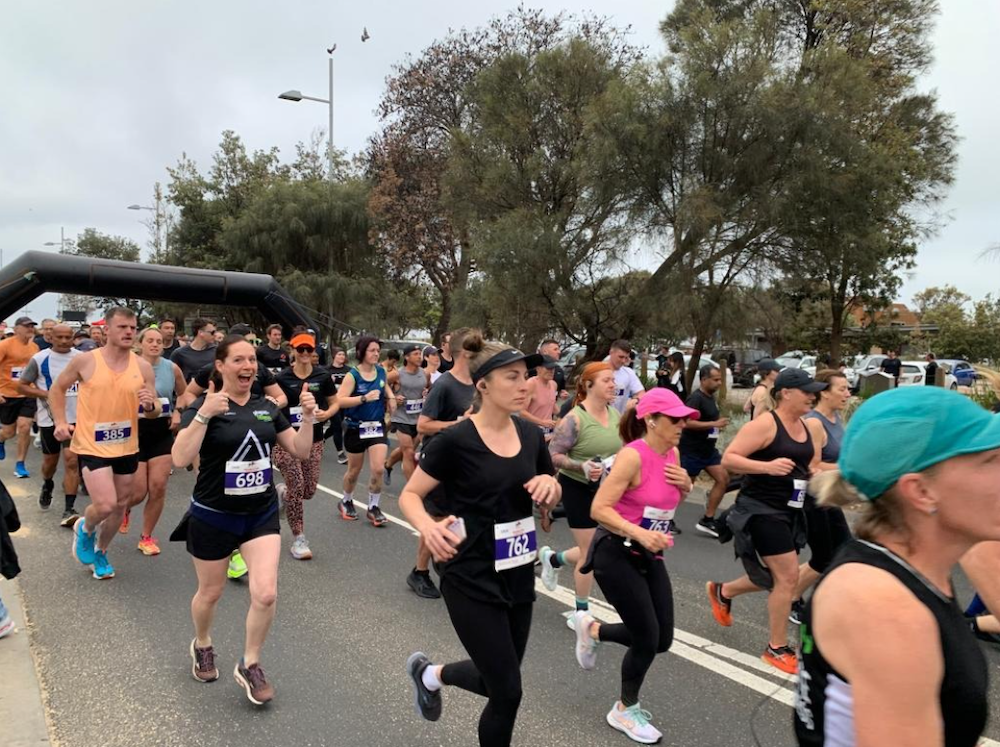
If your goal is running, tennis, hiking or another higher-impact activity, rehabilitation isn’t finished when the pain settles.
The tendon needs to tolerate faster and more powerful movements.
Depending on your goals, this stage may include:
- Skipping
- Hopping drills
- Bounding
- Box step-offs
- Running drills
- Gradual return-to-run programmes
These exercises prepare the tendon for the repeated impact forces that occur during sport.
Don’t forget the rest of the body
One thing I rarely see is gluteal tendinopathy occurring completely on its own.
It’s easy to become focused on the sore hip, but in reality the gluteal tendon is often just the area that’s complaining the loudest. The question we really need to ask is why it became overloaded in the first place.
Sometimes the answer is reduced calf strength, meaning the hip has to work harder every time you walk or run. Sometimes it’s stiffness through the feet or thoracic spine that changes the way you move. For others it may be weakness through the trunk, poor balance, reduced hip mobility or simply years of standing with your weight shifted onto one leg while chatting in the kitchen.
This is why a thorough assessment is so important. Treating the sore tendon without identifying the factors that overloaded it in the first place often leads to the pain settling for a while, only to return again a few months later. When we improve the way the whole body moves, we give the tendon the best chance of staying happy long term.
How much pain is okay?
This is probably the question I answer more than any other.
For many years people were told that pain meant damage and that any discomfort during rehabilitation should be avoided. Thankfully we now understand tendons a little better than that.
A small amount of discomfort while performing strengthening exercises is often acceptable, particularly if it settles soon after you’ve finished. What I’m much more interested in is how your body responds over the next 24 hours. If your symptoms settle back to your normal baseline by the following day, you’ve probably chosen an appropriate level of loading.
On the other hand, if you’re limping around for the next two or three days, struggling to sleep because your hip is flaring up, or each exercise session seems to make things progressively worse, that’s your tendon telling you it wasn’t ready for that amount of load.
Finding that sweet spot is one of the biggest challenges with tendon rehabilitation. Too little loading doesn’t stimulate the tendon to become stronger, but too much can keep it irritated. The art is finding the middle ground where your tendon is being challenged enough to adapt without becoming overwhelmed.
My biggest message
If there’s one thing I’d like you to take away from this article, it’s that perimenopause doesn’t mean you have to stop doing the things you love.
It doesn’t mean you should stop running. It doesn’t mean heavy strength training is suddenly dangerous. And it certainly doesn’t mean sore hips are something you simply have to put up with because you’re getting older.
Your body is changing, and those hormonal changes do influence how your muscles and tendons recover. But that doesn’t mean they stop adapting. Given the right amount of loading, enough recovery and a programme that’s tailored to your body and your goals, tendons are remarkably good at becoming stronger again.
I’ve worked with many women who have returned to running, hiking, strength training, golf and countless other activities after gluteal tendinopathy. The common thread wasn’t finding the perfect exercise. It was understanding the condition, progressing their loading patiently and giving the tendon enough time to adapt.
Your hip isn’t giving up on you.
It might simply be asking you to train a little differently than it did ten years ago.
Written by Morgan Deegan
B Sc (Physiotherapy) – Curtin University
Post Grad Certificate in Sports Physiotherapy – LaTrobe University
Morgan Deegan is a passionate Physiotherapist and Director of Physio and Fitness Clinic. She focuses on treating each client with an individual, goal oriented approach. She is an expert at looking at the body holistically and ensuring that each step of the process to recover is managed and thoroughly understood by the client.
Here at Physio and Fitness Clinic, we can assist you with your health and fitness. Make an appointment with a physio today for physiotherapy and physio run pilates.